PA Commonwealth Court Holds That Solar “Farms” Are Not Agriculture
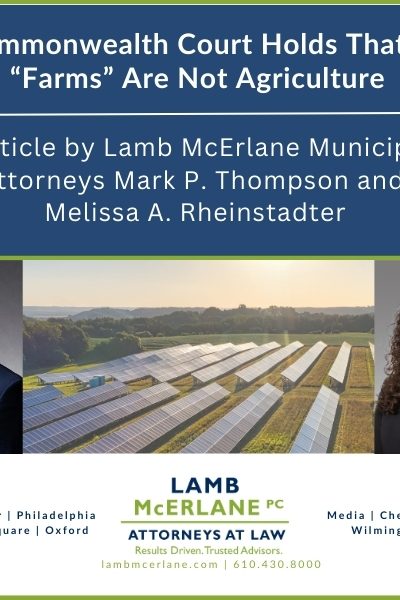
Article / Municipal Update by Lamb McErlane Attorneys Mark P. Thompson and Melissa A. Rheinstadter.
In a decision earlier this year, the Commonwealth Court of Pennsylvania held that agrivoltaics, commonly referred to as “solar farms,” do not constitute an agricultural use. The case, West Lampeter Solar 1, LLC v. West Lampeter Township Zoning Hearing Board, et al., 2026 WL 110932 (Pa. Cmwlth. Jan. 15, 2026), may have broader implications for Pennsylvania farmers seeking to modernize and further monetize their farming practices.
According to the U.S. Department of Energy, Solar Farms, or “Agrivoltaics”, also referred to as “dual-use solar,” is the practice where agricultural products, including crops and livestock, are located under or between solar panels. As stated by the United States Department of Agriculture, a symbiotic ‘cooling’ relationship occurs when growing crops under solar panels; plants growing under the diffused shade of photovoltaic panels are buffered from the day’s most intense rays. In the northeast, the most common form of agrivoltaics involves the integration of livestock grazing and solar panels, referred to as “solar grazing.” Sheep are commonly used to maintain grasses while decreasing fuels and emissions related to mowing. The increasing frequency of agrivoltaics is likely due to farmers’ desire to diversify their activities on their properties.
With this background, the Commonwealth Court analyzed whether the Applicant, West Lampeter 1 LLC, could develop a 25-acre agrivoltaics facility, specifically solar grazing involving sheep, on its 55-acre property. The Applicant’s property was located in West Lampeter Township’s Agricultural District and was subject to the Commonwealth’s Clean and Green Program. The Applicant sought a special exception from the Township, which limited non-agricultural uses on properties within the Agricultural District to less than 5 acres. Thus, the Zoning Hearing Board had to determine whether the proposed agrivoltaics facility was an agricultural use.
The Zoning Hearing Board ultimately determined that the proposed agrivoltaics was not Agriculture and thus denied the application. Without taking additional evidence, the trial court affirmed the Zoning Hearing Board’s holding that the photovoltaic generation of electric power, by itself, is not agriculture – citing the Clean and Green Program’s determination that solar power generation was not an agricultural use.
On appeal, the Commonwealth Court looked to the Township’s Subdivision and Land Development Ordinance’s failure to define the terms “agrivoltaics,” “agriculture,” or “agricultural activities,” and Section 107 of the Municipalities Planning Code (MPC), which defined “agricultural operation,” providing that: “…The term includes an enterprise that implements changes in production practices and procedures or types of crops, livestock, livestock products, or commodities produced consistent with practices and procedures that are normally engaged by farmers or are consistent with technological development within the agricultural industry.” See 53 P.S. §10107 (emphasis added). In light of this definition in the MPC, the Court found that there must be a connection between the technological advance and the preparation of agricultural products, finding that “Here, Applicant’s generation of electricity will not advance sheep grazing enterprise of [property owner]. Each use can be undertaken separately from the other.” Because the Applicant’s 25-acre solar farm exceeded the 5-acre limit for nonagricultural uses, the Court found the use was not permitted, holding that “agrivoltaics is not an agricultural use, and Applicant did not establish that its proposed use complied with the applicable requirements of the Zoning Ordinance for a nonagricultural use.”
With this decision, the Commonwealth Court has further limited the definition of “agriculture” which may cause a significant impact on Pennsylvania’s agricultural community. This case follows a similar pattern to that of the Pennsylvania Agritourism Activity Protection Act (AAPA). In 2021, the AAPA was passed, limiting the definition of what constitutes “agritourism” and, in turn, broadening civil liability of certain activities on agritourism farms such as overnight accommodations, weddings, and concerts. Through both agrivoltaics and agritourism, Pennsylvania farmers who intend to diversify and modernize their properties are now limited. Farmers throughout the Commonwealth will continue to avail themselves of advancing farming technologies, which may not technically constitute “agricultural activities” under the new era of the West Lampeter Solar 1, LLC determination. The Commonwealth’s legislature should consider this decision’s impact on those farmers seeking to focus more on modern day technologies such as agrivoltaics.
____________________________________________________________
Mark P. Thompson is a partner at Lamb McErlane PC, concentrating his practice on municipal, land use, environmental law, and property tax assessment matters. With his experience in the Pennsylvania Environmental Hearing Board and on the Pennsylvania Department of Environmental Protection, Mark also counsels clients in the areas of solid waste, water, sewage, and environmental litigation.
Mark handles a wide variety of municipal, land use, property tax, administrative and environmental law matters and advises townships, boroughs, school districts, and municipal authorities, as well as corporations and individuals. He has represented clients before state and local administrative tribunals, as well as before Courts of Common Pleas, the Commonwealth Court, and the Supreme Court of Pennsylvania. mthompson@lambmcerlane.com, 610.701.4407
Melissa Rheinstadter is an associate attorney at Lamb McErlane PC, concentrating her practice in Municipal and Environmental Law. She handles a wide variety of municipal, land use, and property tax matters. Melissa assists in advising townships, boroughs, school districts, and municipal authorities. She advises both public and private clients on land use, environmental, and municipal matters. Melissa works with her clients, and their professional consultants, to develop effective solutions. mrheinstadter@lambmcerlane.com, 610.701.3271.
*This article is for educational purposes only and is not intended to be legal advice. Should you require legal advice on this topic, or have any questions or concerns, please contact Mark Thompson or Melissa Rheinstadter.
Related Articles
-
Agricultural Security Areas Help to Ensure Agriculture’s Future in Pennsylvania
-
PA Commonwealth Court Holds That Solar “Farms” Are Not Agriculture
Related Articles
-
Lamb McErlane Sponsors Farm to Feet Trail Run at Lundale Farm Benefiting Local Farmers
-
Court Finds Sewer Charges Imposed By Borough May Be Excessive
-
PA Superior Court Rules a Second Class Township May Not Enter into an Individual Life Insurance Policy
-
Pennsylvania Superior Court Confirms that Mandatory Arbitration Provisions do not Extend to Subsequent Homeowners